

Piles, also called hemorrhoids, can make sitting, working, or even using the washroom uncomfortable. Mild cases often improve with fibre, fluids, medicines, and better bowel habits, but persistent bleeding, prolapse, or advanced piles may need a procedure.
Today, many patients compare laser piles treatment with traditional hemorrhoid surgery because the two approaches treat the problem differently. Laser techniques aim to shrink hemorrhoidal tissue with controlled energy, while conventional hemorrhoidectomy removes the enlarged tissue.
Which option means less pain, faster recovery, and better value? This guide compares laser and traditional piles surgery across the factors patients usually care about most.
Laser Piles Treatment vs Traditional Surgery: What Is the Difference?
Traditional piles surgery usually refers to excisional hemorrhoidectomy, in which symptomatic hemorrhoidal tissue is removed using an open or closed technique. Laser hemorrhoidoplasty, a common form of laser surgery for piles, delivers laser energy within the hemorrhoidal tissue to reduce its blood supply and shrink it while limiting tissue excision.
Piles are not identical in every patient. Internal hemorrhoids are graded from I to IV according to prolapse, while external or combined disease may require a different approach. Current ASCRS guidance recommends excisional hemorrhoidectomy for selected patients with external hemorrhoids or symptomatic combined internal and external Grade III–IV disease. Evidence for laser hemorrhoidoplasty is strongest in selected Grade II–III cases, although suitability must always be assessed individually.
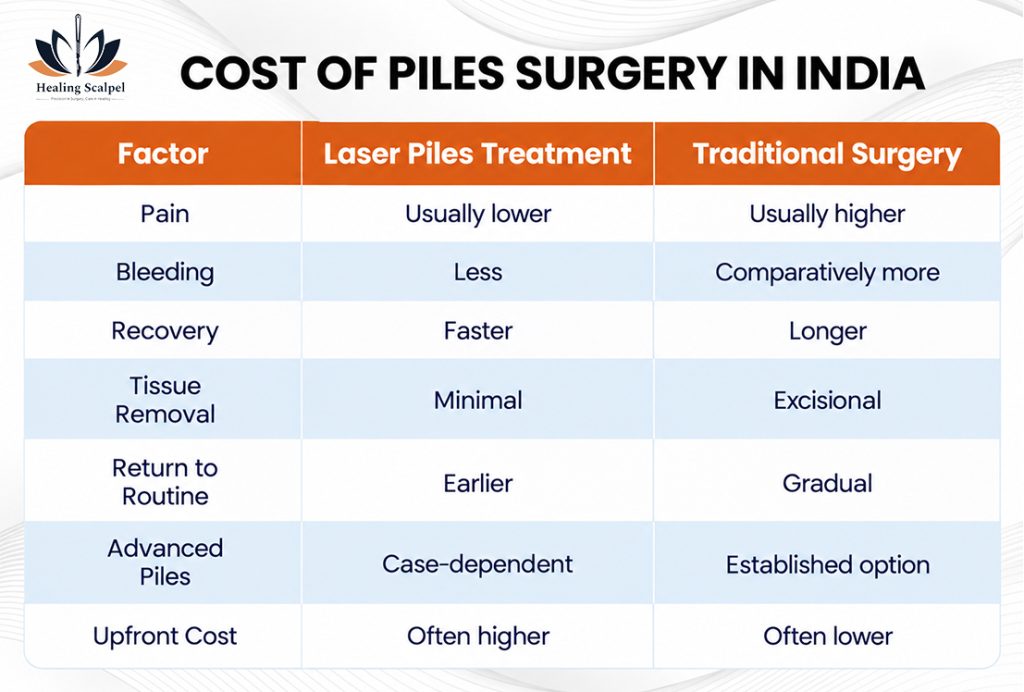
| Feature | Laser Piles Treatment | Traditional Excisional Surgery |
| Approach | Laser energy shrinks hemorrhoidal tissue | Hemorrhoidal tissue is surgically removed |
| Early postoperative pain | Usually lower in comparative studies | Usually higher |
| Bleeding | Generally lower | Can be greater |
| Return to routine activity | Usually earlier | Usually takes longer |
| Long-term durability | Promising, but long-term evidence is less certain | Well established, especially for advanced disease |
| Typical suitability | Selected internal piles, often Grade II–III | Large external/combined or advanced prolapsing piles |
Comparative reviews consistently support better short-term recovery outcomes after laser hemorrhoidoplasty, while newer evidence continues to highlight uncertainty about long-term durability compared with excisional surgery.
Cost, Pain & Recovery: How Do Laser and Traditional Piles Surgery Compare?
The biggest differences between the two procedures are usually seen in postoperative pain, recovery time, and overall treatment cost. Here’s how they compare across these key factors.
Pain After Surgery
Laser piles treatment is generally associated with less early postoperative pain and lower painkiller use than conventional hemorrhoidectomy. However, temporary discomfort, swelling, minor bleeding, or pain during bowel movements may still occur.
Recovery Period
Patients undergoing laser surgery for piles often return to routine activities sooner because there is less tissue excision. Traditional hemorrhoidectomy usually requires a longer healing period, although it may remain more suitable for advanced or extensive piles.
Cost of Piles Surgery in India
The cost of a laser operation for piles varies by city, hospital, pile grade, surgeon, anaesthesia, investigations, and insurance coverage. In major Indian cities, indicative laser treatment costs commonly range from around ₹50,000 to ₹90,000 or more.
Laser procedures may have a higher upfront cost than conventional surgery, but overall expense can also be influenced by hospital stay, medicines, follow-up visits, recovery time, and time away from work.
Advantages, Risks & Who May Benefit From Each Option
Both procedures have specific benefits and limitations. The right choice depends on the type and grade of piles, symptom severity, and expected recovery.
Why Do Patients Consider Laser Piles Treatment?
Common advantages of laser piles treatment include:
- Less early postoperative pain
- Reduced bleeding
- Shorter recovery time
- Earlier return to routine activities
- Less tissue excision
These benefits make laser surgery for piles appealing to patients looking for a quicker recovery, although results can vary depending on the condition.
What Are the Risks and Limitations?
A laser operation for piles can still cause pain, bleeding, swelling, infection, urinary retention, or recurrence. Traditional hemorrhoidectomy may involve more postoperative discomfort and healing time but can be more suitable for extensive or advanced piles.
A surgeon typically considers:
- Type and grade of hemorrhoids
- Degree of prolapse and bleeding
- Previous treatment or recurrence
- External or thrombosed piles
- Overall health and medicines
- Recovery needs
Not every patient needs surgery. Mild or early-stage piles may improve with diet, medicines, bowel-habit changes, or office-based treatments before surgery is considered.
Key Takeaways
Laser piles treatment can offer important short-term advantages, especially less early postoperative pain, lower bleeding, and a faster return to daily activities.
Traditional excisional surgery remains an established option for advanced, external, or combined hemorrhoids and may offer greater durability in selected cases. Cost should be considered alongside pile grade, expected recovery, recurrence risk, and the surgeon’s recommendation.
If persistent piles symptoms are affecting daily life, Dr. Digvijay Singh at Healing Scalpel in Gurugram can assess the type and grade of hemorrhoids and discuss suitable surgical or minimally invasive options. The right treatment is the one matched to the individual diagnosis. Timely assessment can also help rule out other causes of rectal bleeding and avoid unnecessary delay in appropriate care.

FAQs
1. What are the key differences between laser piles treatment and traditional surgery?
Laser piles treatment shrinks hemorrhoidal tissue using controlled laser energy, while traditional surgery removes the affected tissue. Laser procedures often involve less early pain and faster recovery.
2. What are the advantages of laser piles treatment over conventional surgery?
Laser piles treatment may offer less postoperative pain, reduced bleeding, and an earlier return to routine activities. Suitability, however, depends on the type and grade of piles.
3. How long is recovery after laser surgery for piles compared with traditional hemorrhoidectomy?
Laser surgery for piles is generally associated with a quicker return to normal activities, while traditional hemorrhoidectomy usually requires a longer healing period.
4. Are there any risks associated with laser piles treatment?
Yes. Laser piles treatment can still involve pain, bleeding, swelling, infection, urinary retention, or recurrence, although short-term recovery is often more comfortable.
5. What is the cost of laser piles surgery in major Indian metropolitan areas?
A laser operation for piles in major Indian cities may cost roughly ₹50,000 to ₹90,000 or more, depending on pile grade, hospital, surgeon, anaesthesia, and insurance coverage